Submissions for Bloomberg New Contempories 2018 is open between 10am Monday 4 December 2017 and 5pm Monday 22 January 2018.
Apply online here: http://submissions.newcontemporaries.org.uk
Blog
Paul Kingsnorth on Ecology
And so I ask myself: what, at this moment in history, would not be a waste of my time? And I arrive at five tentative answers:
[Full article here: https://orionmagazine.org/article/dark-ecology/]
One: Withdrawing. If you do this, a lot of people will call you a “defeatist” or a “doomer,” or claim you are “burnt out.” They will tell you that you have an obligation to work for climate justice or world peace or the end of bad things everywhere, and that “fighting” is always better than “quitting.” Ignore them, and take part in a very ancient practical and spiritual tradition: withdrawing from the fray. Withdraw not with cynicism, but with a questing mind. Withdraw so that you can allow yourself to sit back quietly and feel, intuit, work out what is right for you and what nature might need from you. Withdraw because refusing to help the machine advance—refusing to tighten the ratchet further—is a deeply moral position. Withdraw because action is not always more effective than inaction. Withdraw to examine your worldview: the cosmology, the paradigm, the assumptions, the direction of travel. All real change starts with withdrawal.
Two: Preserving nonhuman life. The revisionists will continue to tell us that wildness is dead, nature is for people, and Progress is God, and they will continue to be wrong. There is still much remaining of the earth’s wild diversity, but it may not remain for much longer. The human empire is the greatest threat to what remains of life on earth, and you are part of it. What can you do—really do, at a practical level—about this? Maybe you can buy up some land and rewild it; maybe you can let your garden run free; maybe you can work for a conservation group or set one up yourself; maybe you can put your body in the way of a bulldozer; maybe you can use your skills to prevent the destruction of yet another wild place. How can you create or protect a space for nonhuman nature to breathe easier; how can you give something that isn’t us a chance to survive our appetites?
Three: Getting your hands dirty. Root yourself in something: some practical work, some place, some way of doing. Pick up your scythe or your equivalent and get out there and do physical work in clean air surrounded by things you cannot control. Get away from your laptop and throw away your smartphone, if you have one. Ground yourself in things and places, learn or practice human-scale convivial skills. Only by doing that, rather than just talking about it, do you learn what is real and what’s not, and what makes sense and what is so much hot air.
Four: Insisting that nature has a value beyond utility. And telling everyone. Remember that you are one life-form among many and understand that everything has intrinsic value. If you want to call this “ecocentrism” or “deep ecology,” do it. If you want to call it something else, do that. If you want to look to tribal societies for your inspiration, do it. If that seems too gooey, just look up into the sky. Sit on the grass, touch a tree trunk, walk into the hills, dig in the garden, look at what you find in the soil, marvel at what the hell this thing called life could possibly be. Value it for what it is, try to understand what it is, and have nothing but pity or contempt for people who tell you that its only value is in what they can extract from it.
Five: Building refuges. The coming decades are likely to challenge much of what we think we know about what progress is, and about who we are in relation to the rest of nature. Advanced technologies will challenge our sense of what it means to be human at the same time as the tide of extinction rolls on. The ongoing collapse of social and economic infrastructures, and of the web of life itself, will kill off much of what we value. In this context, ask yourself: what power do you have to preserve what is of value—creatures, skills, things, places? Can you work, with others or alone, to create places or networks that act as refuges from the unfolding storm? Can you think, or act, like the librarian of a monastery through the Dark Ages, guarding the old books as empires rise and fall outside?
Moulding Futures: Collaborative Explorations in Ceramics for Architecture
RIBA North is pleased to host the Moulding Futures: Collaborative Explorations in Ceramics for Architecture symposium, a one-day event presented by the Environmental Ceramics for Architecture Laboratory (ECAlab), on Friday 8th December 2017.
The symposium is presented in conjunction with the exhibition Cerámica, RIBA North, Gallery ONE 28th October 2017 through 10th February 2018.
Major advances in ceramics engineering and craftsmanship have opened new routes for innovation, triggering the re-emergence of ceramics as a sensory and culturally inspiring material in architecture. This event will present innovative trends in contemporary architectural ceramics production, bringing together some of the most prominent national and international minds connected to ceramics design and engineering. It intends to spark a discussion around the multiple attributes of ceramics as a versatile and phenomenological architectural material. Through our speakers presentations and chaired discussions, we will explore a wide range of topics relating to ceramics architecture, such as:
- the aesthetic, phenomenological and spatial effects of ceramics;
- the environmental and technical performance of ceramics;
- social and environmental sustainability;
- digital fabrication technology, and innovative design methodologies and production processes;
- digital and traditional crafts;
- patterns, surface effects and new interpretations of ornament;
- heritage, contextualism, local knowledge and cultural identity.
- the re-consideration of clay and its renaissance as an innovative building material
ECAlab is funded and directed by Rosa Urbano Gutiérrez and Amanda Wanner www.ecalab.org
Alongside the international speakers, there is an invited audience of Architects, Engineers, Ceramicists, Manufacturers and Academics who will contribute to the 2 chaired discussions, and there are a limited number of tickets that will be released through Eventbrite.
https://www.eventbrite.co.uk/e/moulding-futures-architectural-ceramics-symposium-tickets-40096396401
The eventbrite page lists the itinerary for the day, and registration for the day will begin at 8.30. For those who need to arrange their homeward travel, the day will conclude by 5.30 but discussions will continue with drinks afterwards. Food and refreshments throughout the day.
We hope that this will be an inspirational day of presentations and we have the following confirmed speakers.
Eric Parry, Eric Parry Architects, London
http://www.ericparryarchitects.co.uk
Antoni Cumella, Cumella, Barcelona
Martin Bechthold, Harvard University, USA
http://www.gsd.harvard.edu/person/martin-bechthold/
Alexsis Harrison, ARUP Engineers London
Maximilliano Arrocet, AL_A, London
If anyone has any questions, I am happy to answer these at a.wanner@leedsbeckett.ac.uk
Chris Speyer at Ibstock
I went to visit Chris at Ibstock Cattybrook in Almondsbury (just north of Bristol) last week. Great progress on the first of two large pieces being produced for the Masters Project.

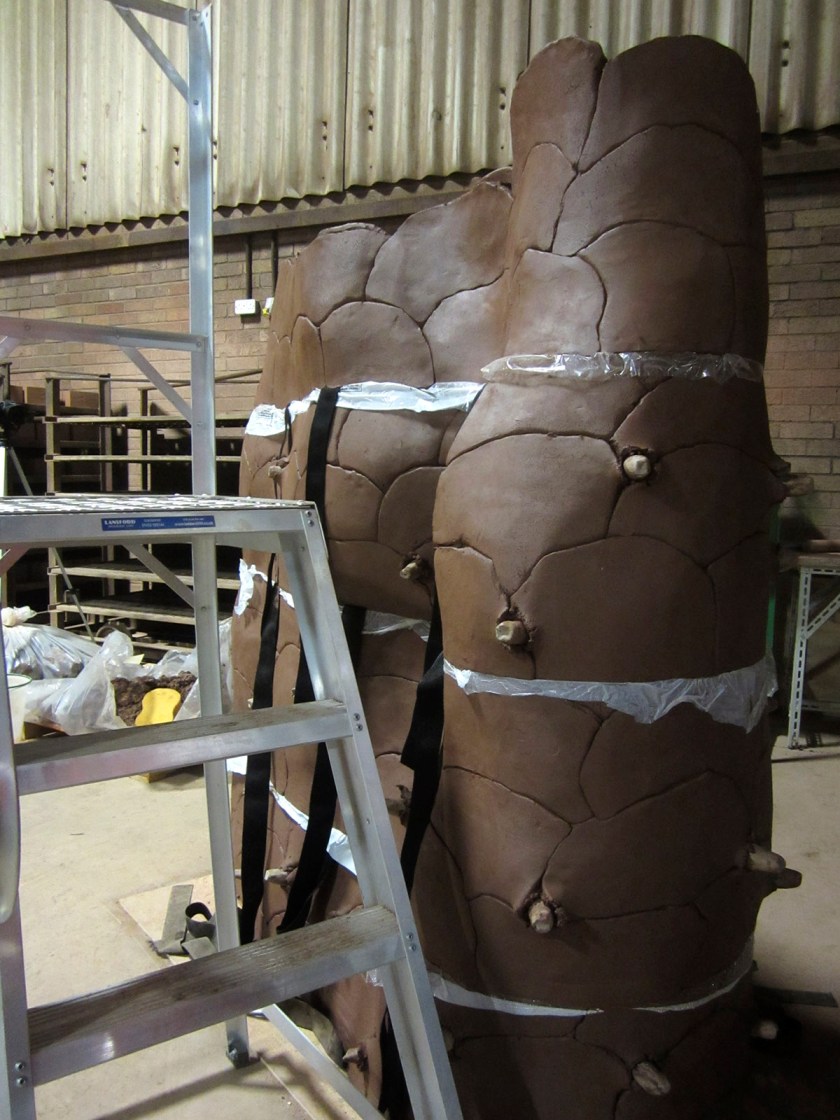
And the finished piece a few days later:
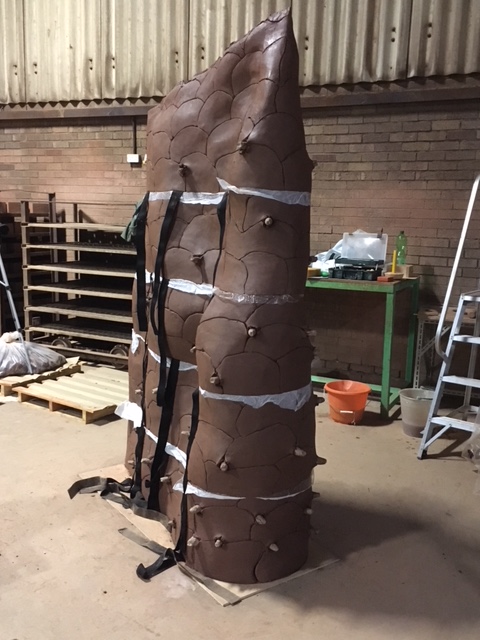
Good luck with number two Chris…
writing making | making writing: retaking the side of things
 PAC Home Talk [Plymouth Arts Centre]
‘writing making | making writing: retaking the side of things’
Wednesday 13 December, 6:00pm
Dr Conor Wilson will talk about the process of working with Clare Thornton on the production of a prose poem, Light Pricks : Whispers and Kicks, for a publication to accompany her forthcoming exhibition, Materials of Resistance. Wilson will give a first performance of the multi-vocal text and will open up the production process with reference to writing-making methods he developed during a practice-based PhD project, and the creative method of Francis Ponge.
Clare Thornton and Ben Borthwick, Artistic Director of Plymouth Arts Centre, will join Wilson for a Q&A after the talk.
https://plymouthartscentre.org/whats-on/conor-wilson-pac-home-talk/
 BSAD Ceramics
You must be logged in to post a comment.