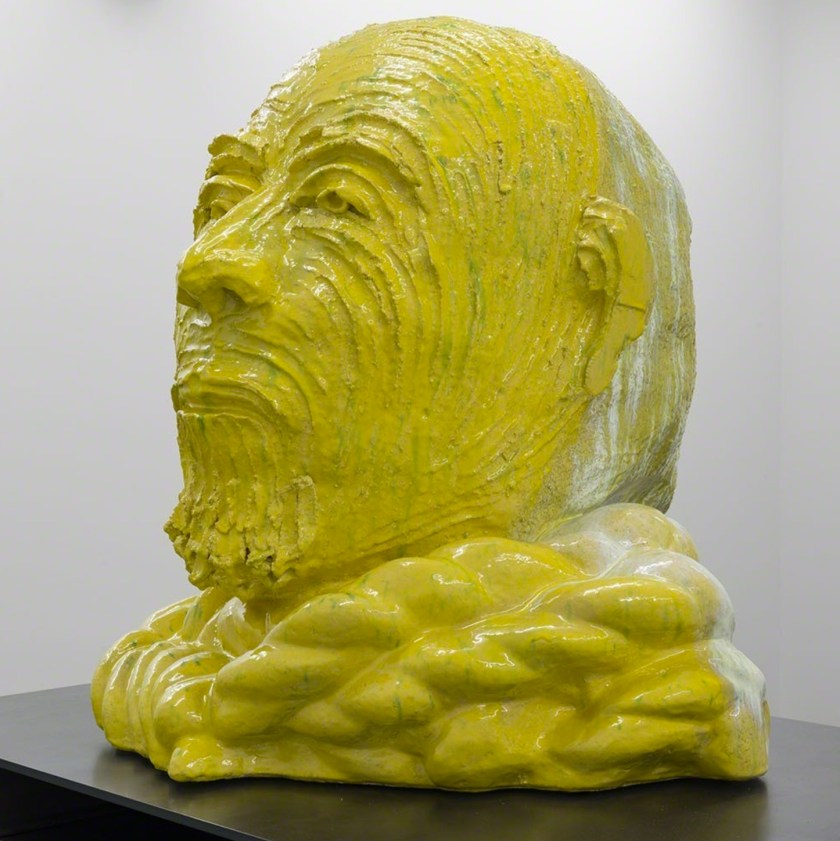
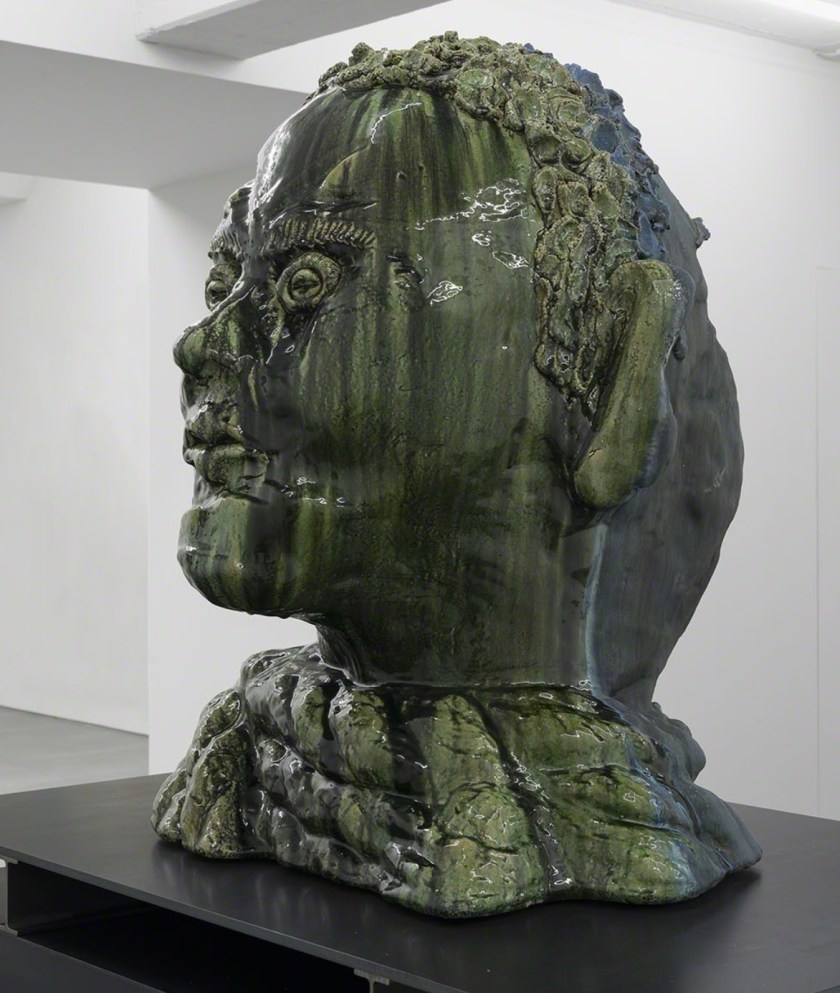
More on cfile here.
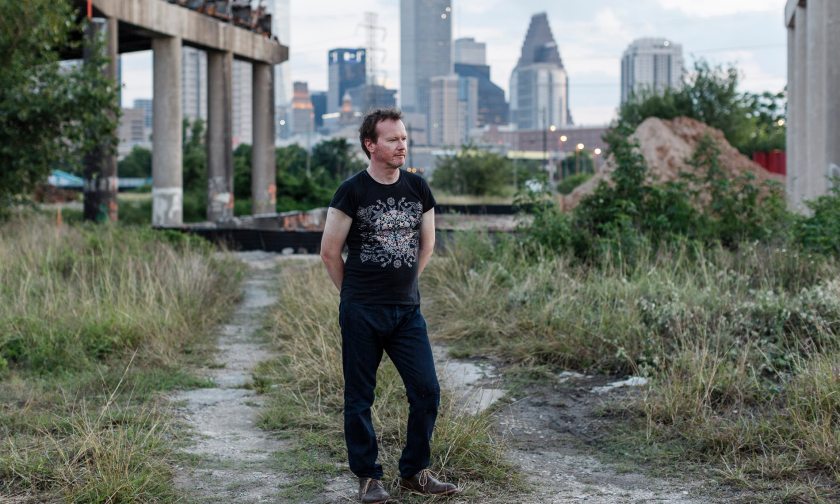
If you had to select an avatar for the Anthropocene, Morton might be an appropriate choice. He has arctic-blue eyes that at once shock and appear shocked. Combined with a slight pudginess that suggests physical vulnerability, an eczematic redness to his face, and a thistle of thin blond hair, he looks as if he has survived some kind of fallout. Indeed, he is something of a man afflicted. Among other things, he suffers from severe sleep apnoea, severe depression, severe migraines, and, it seemed to me over the course of our conversations, the occasional bout of mild paranoia. [Hans Ulrich] Obrist, who has recorded more than 2,500 hours of interviews with artists and philosophers, told me that Morton is the only one who became “so emotional that actually he starts to cry”. (They had been discussing mass extinction.)…
…From early on, Morton was an academic standout. He received the top scholarship at the elite St Paul’s School in London five years in a row, and then went to Oxford to read English. He got the highest marks in his subject across the university in his first-year exams, and a first in his finals. Doing well academically was important to Morton, but eventually he came to the realisation that it’s “actually secondary to this other thing, called being alive”. His life took on something of the shape his work would later adopt. It was about more than accumulating knowledge; it was also about pursuing pleasure and intimacy. In his second year as an undergraduate, he and his roommate, Mark Payne, who is now a classicist at the University of Chicago, would “do acid and listen to Butthole Surfers and talk about Blake”. (Payne says they did acid and talked about Milton.) He also fell in love for the first time. As a graduate student, Morton wore his hair long, with a suede jacket, and decked himself out in beads. His PhD thesis, which is recognised as an important contribution to the study of Romanticism, showed that the vegetarianism of Percy and Mary Shelley was intimately entwined with their politics and art. Paul Hamilton, who supervised some of Morton’s graduate work, told me that, when it came to the Shelleys, Morton “changed the lights for everyone”.
Despite the success of his dissertation, Morton struggled to land an academic position, and even contemplated killing himself…
Loving Morton is a triumph for optimism and an acceptance of complexity and ambiguity. Don’t listen to the poo pooers; be inspired by the OOOers…
Full article here
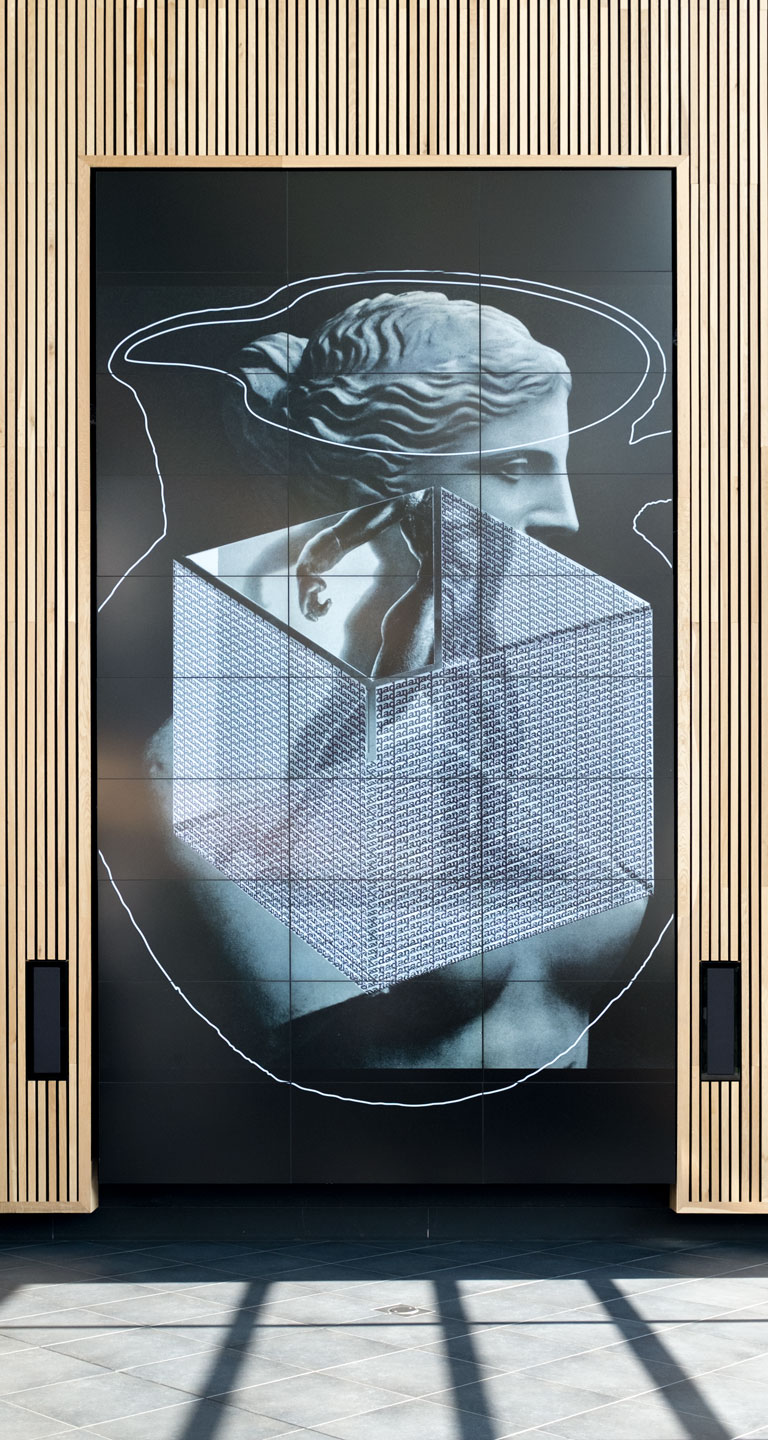
Photo by Neil Glen
Dr Conor Wilson’s A Game of Jug is showing on the MediaWall, in the Commons building at Newton Park, Bath Spa University (until 29 June).
A loop of thirty images show for a minute each on the thirty-screen wall, which is over seven metres in height. This gives a unique opportunity to see these layered, high-resolution images in all-at-once detail.
Wilson has developed a practice-research process that incorporates making, drawing, documenting, writing and existing objects – the latter often included through ‘guided chance’. The exhibited images are by-products of an ongoing ‘game of Jug’, instigated by Martin Heidegger’s essay, ‘The Thing’, and the subsequent purchase of a jug made at Prinknash Abbey, home and workplace of concrete poet, Dom Sylvester Houédard. Two further texts [‘The Handle’ by Georg Simmel and ‘me as poet rather than critic’ by Dom Sylvester Houédard] and two books of images were added to the game, setting up a play between analogue and digital, image and text, two and three dimensional making.
I am starting an occasional series of ceramics in the domestic environment. Send me an image or two of something you own and love and I will post…
First up, one from my own collection:
Josh Redman, Aboriginal [a cup with a name!] (c 2009)


We juggle all three. We are none and all. We develop our understanding of the world around us through material (and social) investigation. The multifarious materials and processes of ceramics are our starting point, our structuring device.
We develop as autonomous learners – independent, resourceful and resilient.
We look inwards and we look outwards – we create value through our labour and the depth of our engagement. We share, we give and we learn to trade in the attention economy.
 BSAD Ceramics
You must be logged in to post a comment.